The last time I asked to see my family doctor, the first free slot was a month away. Most people in Lithuania have a story like this, and for specialists it is worse. In a September 2025 survey of 1,017 residents, about a third said they wait two to three months for a specialist, and 45% said their health had got worse at least once while they waited.
Meanwhile, every day, some patients at that same clinic cancel or don't turn up. The doctor is there and paid, and the chair is empty. Lithuania publishes no national no-show figure; polyclinic directors have told the press it is 9–24%.
A process that leaks at every step
When we talked to Lithuanian hospitals and clinics, nobody described a single fault. One hospital called outpatient queues its number one operational problem: when a slot opens, a receptionist phones down the waiting list one person at a time. Another clinic asked for text messages patients could answer: I'll come, I won't come, give me another time. A third had already tried an AI scheduling agent and dropped it, because receptionists could find a free slot faster by hand.
Last October LRT reported on an 80-year-old woman who was number 238 in a six-month queue for one neurosurgeon. The hospital then said any of its neurosurgeons could see her within three weeks. The capacity existed. Nobody matched her to it.
We picked the gap where the waste is easiest to see: the cancelled appointment that nobody refills.
What a simulated year showed
Testing new booking rules on a real clinic is slow and risky, so we built a simulator. It plays out a year in a made-up department modelled on a large city polyclinic, eleven specialists across three sites, calibrated to public Lithuanian figures and populated with synthetic patients.
We started with the clinic as it runs today. When someone cancels, registry staff ring round, most urgent patient first, in the time they have for it on weekdays. They refilled 12% of cancellations. The desk ran out of hours, and thousands of freed slots a year expired before anyone could phone about them. Patients waited 42 days on average, and only a quarter of first visits happened within 30 days.
The obvious fix is reminders, and many Lithuanian clinics already send them. In the model, missed appointments fell from 14% to 10%, close to the drop a Cochrane review of text reminders found. But the average wait barely moved, from 42 days to 40. A reminder mostly turns a missed visit into an early cancellation, and the slot goes back to the same overloaded desk. An NHS outpatient service saw this in real life: short-notice cancellations rose once texts went out, and only 57% of the freed slots were refilled.
So the bottleneck wasn't the patients. It was the step between “a slot is free” and “someone is in it”.
Next we replaced the phoning with an automated assistant that messages suitable patients at any hour and moves on after ten minutes without a reply, overseen by a person at about a minute per contact. Refills went from 12% to 71%, and the average wait fell to 26 days.
Now reminders paid off too, because the slots they freed had somewhere to go. Together, the two cut the average wait from 42 days to 22, and first visits within 30 days rose from 25% to 73%. The clinic saw about 5,900 more visits a year with the same doctors, and idle doctor time fell by about 1,650 hours, roughly one full-time doctor's working year. Valued at doctor pay, less staff time and text messages, that is worth about €51,000 a year to this one department.
How patients were asked mattered far more than the rule for choosing whom to ask. Once contact is cheap, asking the most urgent patient first gets most of the benefit.
Every number here comes from the simulator. The assistant sends about 130,000 messages a year, and the model doesn't stop it messaging one patient about several slots in a row; a real service would need a limit, which would reduce the gains. The minute of oversight is our estimate, and the reminder effects come from the Cochrane review and one NHS service, because Lithuania has no trial of its own.
What we built
The prototype is a web app for the receptionist. When a patient cancels, the freed slot arrives in the receptionist's inbox as a case. Opening it shows only the patients who can take the slot: the right specialty, a doctor they accept, a location they can reach, a date inside their window and a time they said they are free. Anyone who fails a condition is left out, not ranked lower. The list is ordered by clinical priority, which a clinician sets and the system never decides, and then by how long the patient has waited. Every candidate comes with the reason in plain words, for example “High priority · waiting 82 days · patient accepts this doctor”, and an estimate of how likely they are to say yes.
When the receptionist starts the offers, the system texts the first candidate, who answers YES or NO. After ten minutes without a reply the offer moves on to the next person, and the patient who didn't answer keeps their place in the queue. A YES books the slot and closes the case. Nothing reaches a patient until the receptionist starts it. For demos, the texts can be simulated instead of sent.
How the prototype handles one cancellation
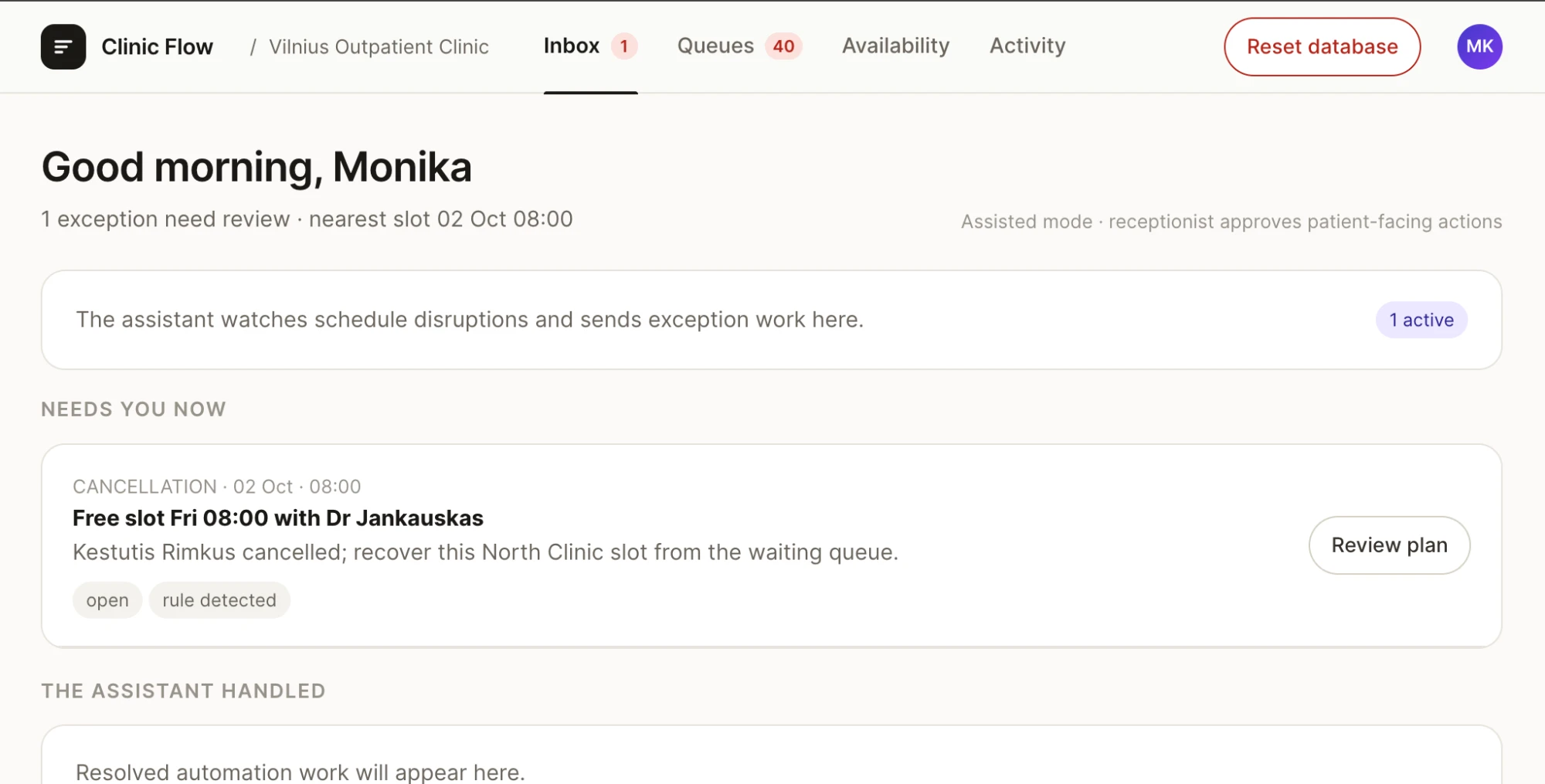
Inbox. A patient cancels a Friday 08:00 appointment. The freed slot arrives in the receptionist's inbox as a case, detected automatically.
Step 1 of 5The failed AI agent taught us one rule: the list must appear faster than a receptionist could find a patient by hand, or it won't be used.
Where this goes next
Booking breaks at several points, and the reminders showed that fixing one of them on its own can just push the problem to the next step. Refilling freed slots is where it piles up, so we started there.
We are now contacting Lithuanian hospitals and polyclinics to demo the prototype. If your registry staff spend their mornings phoning down a list, get in touch, and we will show you what it looks like when the list does the work.