AI is now part of how businesses across every sector operate, and with that comes a learning curve most teams only discover mid-project. Here's one story that taught us just as much as it taught our model.
Imagine this: a client wants the AI model to count boards in a photo:
 Easy! We grabbed a bunch of board photos, trained the model to recognize and count them. After weeks of trials, testing, and fine-tuning, the model worked flawlessly: it marked every board, gave the exact count - even neater than we could do ourselves.
The client was happy, everyone was satisfied.
A few months go by… the client gets a new type of board. They take a picture, send it over, run it through the model.

The result? Our AI reacts as if seeing a foreign language: "Are these… tables? Bricks? Pieces of the neighbor's fence?" - anything but boards.
And then we saw the photo. The new boards were completely different in shade, wider, with a different texture, lacking the familiar markings we had trained on before.
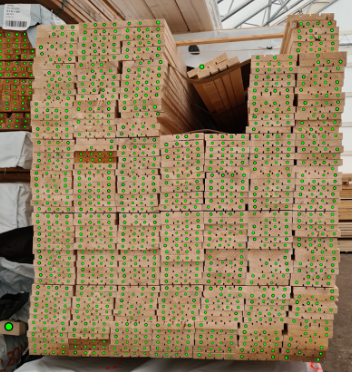
The result: instead of accurate counts - total chaos.
Lessons We Learned Along with the AI
- Data diversity is critically important. If we are training a model to recognize objects, we must show it as many real variations as possible: different colors, shapes, lighting conditions, new manufacturing designs. In other words - if the model only learns from "one type of board," it will get confused when it sees another.
- AI is not a "set it and forget it" solution. The world changes. Products change. When a new, previously unseen case appears, the model needs additional training. This doesn't mean the first model was bad - it's simply a natural process of evolution.
- Plan for model maintenance from the very start. When developing an AI project, include model updates in the strategy. AI is not a static app, but a living mechanism that must learn alongside you.
Today, our model once again counts all boards perfectly - old, new, and even ones it sees for the first time. But this story became a great reminder that AI learning never truly ends.
This story is also a reminder that the model has to address your specific needs. A model built and fine-tuned for your exact products and processes will always outperform a generic one. That is the core argument behind choosing custom AI over off-the-shelf alternatives, and cases like this one show why.