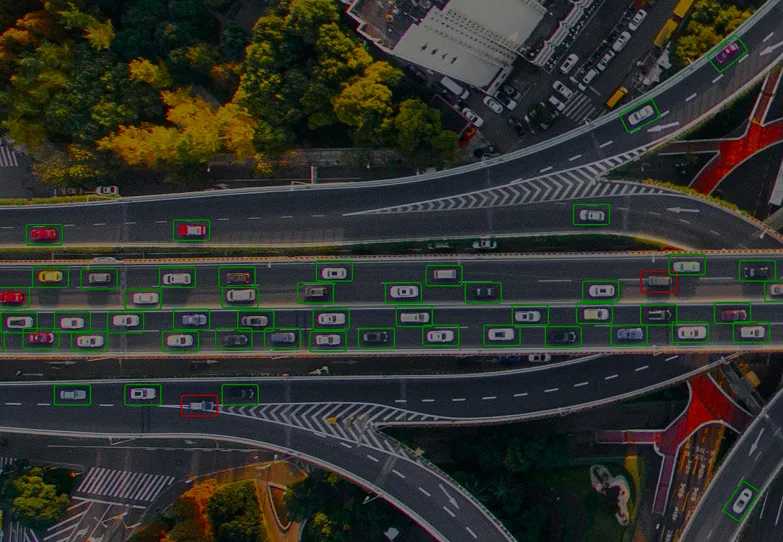
Manual road inspections typically took 6-8 weeks per cycle, delaying repairs and leaving safety issues unresolved in the meantime. Our client, a private transport operator, needed a way to detect road damage and traffic violations in real time, without waiting on manual inspection crews or committing to a full-scale fleet upgrade before the concept was proven.
Technical solution
AAI Labs deployed a squadron of autonomous drones equipped with AI vision to monitor pilot routes continuously, day and night. Rather than treating the drones as passive cameras, we built a full pipeline around them — detection, communication, power management, and reporting — so the system could run unattended for extended periods.
AI-powered aerial vision
A YOLOv10-based object-detection pipeline processes both RGB and thermal footage in real time, identifying potholes, cracks, and traffic violations as they occur. Running detection on thermal alongside standard video lets the system keep working through poor lighting and at night, when many manual inspection schedules simply stop.
Low-latency 5G connectivity
Video and detection data move over a 5G link between the drones and ground stations, keeping the image-recognition pipeline fed with a continuous, low-latency stream rather than batches of footage collected and reviewed after the fact. This is what makes issues visible within minutes of occurring, instead of at the end of a multi-week inspection cycle.
Uninterrupted operations via automated battery swapping
Short flight times are the usual limiting factor for drone-based monitoring. We addressed this with an automated battery-swapping mechanism that lets the squadron rotate in and out of service without a technician on site, eliminating the downtime that would otherwise break up continuous coverage of a route.
Geospatial mapping and alerting
Every detected issue is plotted on a geospatial map and pushed to an alert dashboard, giving the relevant authorities an exact location and a live picture of the route's condition, rather than a written report compiled days or weeks after an inspection.
Results
- Inspection cycles cut from 6-8 weeks to a matter of hours on pilot routes.
- An estimated 65% reduction in operational inspection costs.
- Issues are flagged instantly, letting crews respond within a day instead of weeks.
Future potential
The same pipeline — aerial AI vision, low-latency connectivity, and automated power management — generalizes well beyond road surfaces. Rail corridors, bridges, and other linear infrastructure face the same manual-inspection bottleneck, and could be monitored the same way. Extending the alert dashboard with historical trend data would also let authorities move from reactive repairs toward predictive maintenance, prioritizing the routes most likely to need attention next.